
 EN
EN PT
PT


Head Offices:
Hotline: (877) 289-6429
Working Hours:
Monday to Saturday 6:00 AM – 7:00 PM, Sunday Closed
Website: https://mrmsteel.ai/
What Is Cold Rolled Coil (CRC ) Steel? In the context of modern industry, which increasingly demands high precision, aesthetics, and processing efficiency, cold rolled steel CRC has become one of the indispensable materials in the manufacturing supply chain. With a smooth surface, uniform thickness, and stable mechanical properties, CRC steel not only meets stringent technical requirements but is also suitable for industries that emphasize finishing quality such as automotive, electrical appliances, precision engineering, and furniture. Understanding the nature, production process, and technical standards of CRC steel helps enterprises select the right material, optimize costs, and improve production efficiency.
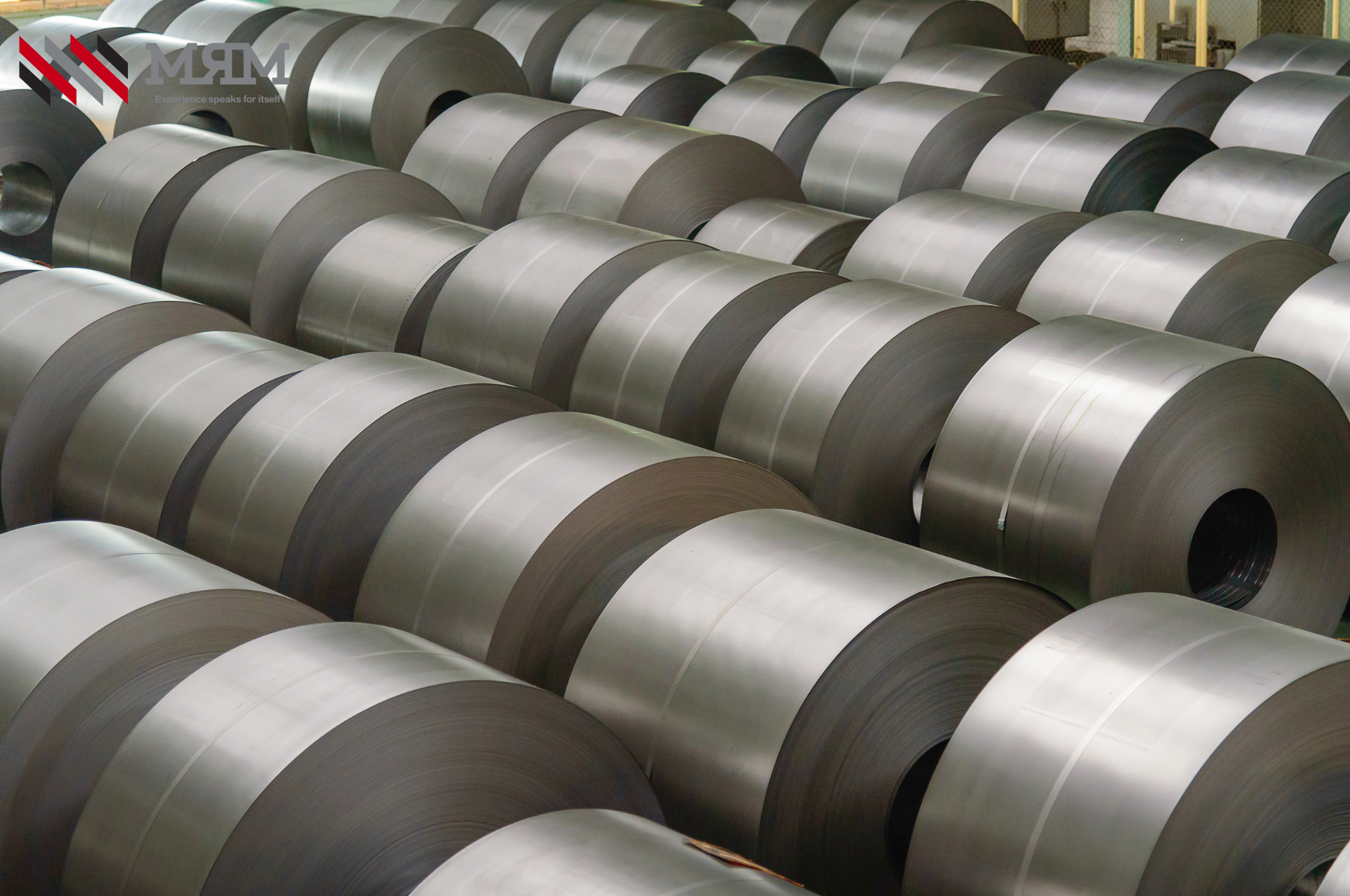
CRC steel (Cold Rolled Coil) is a low-carbon steel produced by cold rolling technology, in which the steel is rolled at low temperatures (near room temperature) — below the recrystallization temperature of the material.

Unlike hot rolling, which uses high temperatures to form steel, the cold rolling process of Cold Rolled Coil steel relies entirely on extremely high pressure from the rolling mill system, compressing and elongating the steel into sheets with precise thin thickness. As a result, CRC steel possesses a flat and smooth surface, high gloss, low dimensional tolerance, and superior mechanical properties compared to many other steel grades.
With advantages in aesthetics, precision, and machinability, CRC steel has become an indispensable base material in industries requiring high standards such as automotive, electrical and electronics, refrigeration, and furniture manufacturing. The perfectly painted metal surfaces you often see on car bodies, refrigerators, or washing machines may very well have Cold Rolled Coil steel as the core material underneath.
To produce cold rolled steel CRC from hot rolled steel (HRC) as the input material, the production process usually includes two main stages: pickling and cold rolling, followed by subsequent mechanical property treatments depending on usage requirements and the desired mechanical condition.
After leaving the furnace, hot rolled steel HRC typically has a dark, rough surface covered with iron oxide scale formed during high-temperature rolling. Before cold rolling, the steel coil must pass through a pickling line using acid solutions (most commonly HCl) to completely remove the surface oxide layer. This stage helps the steel achieve a clean, uniform surface, creating ideal conditions for cold rolling, while also minimizing surface defects and improving final product quality.
This is the key stage that directly determines the thickness, flatness, dimensional accuracy, and mechanical properties of CRC steel. During this process, the steel is rolled at room temperature under high pressure from rolling mills, reducing thickness and significantly improving surface quality. Plastic deformation in the cold state causes work hardening, increasing tensile strength and hardness, while ductility and formability decrease.
If the process ends at this stage, the resulting product is Full Hard CRC steel. This type of steel has high hardness, high yield strength, and limited deep-drawing capability, and is commonly used for applications that do not require complex forming, or as an intermediate material for subsequent processes such as annealing, coating, or cladding, depending on the technical requirements of each manufacturer.
For applications requiring high ductility, formability, and deep drawing capability, cold rolled steel must undergo an annealing process after cold rolling. The purpose of annealing is to recrystallize the grain structure, relieve residual stresses generated during cold rolling, and adjust the mechanical properties of the steel toward a softer, more stable, and more easily machinable condition.
Depending on the annealing method (continuous annealing – CA or batch annealing – BA), the steel after annealing will achieve mechanical properties and surface quality suitable for different technical requirements of the automotive, electrical appliances, household goods, and furniture industries.
| Item | CA Steel (Continuous Annealed) | BA Steel (Batch Annealed) |
| Nature | Cold rolled steel after annealing | Cold rolled steel after annealing |
| Annealing technology | Continuous annealing on CAL line | Discontinuous annealing using bell furnace |
| Processing method | Steel coils move continuously through heating – soaking – cooling zones | Steel coils are stacked in batches and annealed in a sealed furnace |
| Mechanical properties | Uniform and stable along the production line | Good ductility, deep and stable mechanical properties |
| Typical applications | Automotive, electrical appliances, household goods, mass production | Applications requiring high quality and good formability |
| Item | Cold Rolled Steel Coil | Hot Rolled Steel Coil |
| Tolerance | Larger tolerance because during production the steel is hot and then gradually cools, causing self-deformation that is not fully controlled | Smaller tolerance because temperature during production is reduced and better controlled, along with the effect of cooling solutions |
| Typical thickness | 0.15 mm – 2 mm | From 0.9 mm upward |
| Surface | Bright white, high gloss due to a thin oil coating on the surface | Characteristic dark blue-black surface |
| Edge condition | Usually edge-trimmed with straight and sharp edges | Coil edges are usually rounded, rough, and may discolor or rust when stored for a long time |
| Storage | Cold rolled products are usually packaged and stored indoors; they rust very quickly if not properly stored | Stored in dry places, avoiding contact with water because they are prone to rust |
In sheet metal processing engineering, material selection is not based on appearance but entirely on mechanical properties and dimensional tolerances. International standard systems help standardize these parameters to ensure product consistency.
Currently, the Vietnamese cold rolled steel market is governed by three main standards: JIS G3141 (Japan), EN 10130 (Europe), and ASTM A1008 (United States).
| Parameter | Meaning |
| Yield Strength | The minimum force required to cause permanent deformation of steel. The lower this value, the softer and easier the steel is to bend and form. |
| Tensile Strength | The maximum force the steel can withstand before fracture. |
| Elongation | The ability of steel to stretch. The higher this percentage, the more ductile the steel is, allowing it to be deep drawn into complex shapes without tearing. |
This is the most commonly used standard, classifying steel based on formability from low to high:
SPCC (Commercial Quality): The most common low-carbon steel grade. However, SPCC has the disadvantage of material aging over time. If stored for more than three months, the steel tends to increase in hardness and develop stretcher strains on the surface during forming. Therefore, SPCC is suitable for simple bending applications, press forming, or flat sheets.
SPCD (Drawing Quality): This grade has better ductility than SPCC. Thanks to aluminum deoxidation treatment, SPCD has stable properties and does not age over time. It is suitable for forming parts with moderate drawing depth such as washing machine casings and rice cooker covers.
SPCE (Deep Drawing Quality): This steel has a fine and uniform grain structure with high elongation. SPCE is specifically designed for parts undergoing large and complex deformation such as fuel tanks and automobile bodies without necking or cracking.
European Standard: EN 10130
This standard places special emphasis on surface quality and uniformity of mechanical properties and is commonly required in export projects or global supply chains.
DC01: Equivalent to SPCC
DC03: Equivalent to SPCD
DC04: Equivalent to SPCE (low yield strength, high ductility)
EN 10130 divides surface quality into two distinct grades:
Surface A: Allows minor defects such as small pores, light scratches, or color variations, provided they do not affect forming or conventional painting processes.
Surface B: High-quality surface. One side of the steel sheet must be free of defects to serve high-gloss paint coatings, commonly applied in automotive exteriors and high-end household appliances.
ASTM A1008 is the standard applied to Cold Rolled Coil steel sheets and coils, in which chemical composition and mechanical properties are strictly controlled to ensure the steel meets its intended use and formability requirements for each grade. According to ASTM A1008, CRC steel is classified as follows:
CS (Commercial Steel): Includes Type A, B, and C, with Type B being the most common in practice. Carbon content ranges from 0.02% to 0.15%, suitable for general forming applications that do not require complex deep drawing.
DS (Drawing Steel): Requires low carbon content (≤ 0.08%) to improve ductility and formability, suitable for parts requiring bending and light drawing.
DDS (Deep Drawing Steel): Designed for deep drawing applications requiring high ductility, stable material structure, and large deformation capacity without cracking.
EDDS (Extra Deep Drawing Steel): The highest formability grade under ASTM A1008. It typically belongs to the IF (Interstitial Free) steel group, alloyed with Titanium (Ti) or Niobium (Nb) to completely eliminate interstitial elements such as C and N, thereby achieving superior ductility and optimal shape stability.
Cold rolled steel (CRC) is an indispensable link in the manufacturing supply chain thanks to the perfect balance of three factors: surface quality, dimensional accuracy, and plastic deformation capability. This material is widely used across key manufacturing sectors such as:
Vehicle body structure: Main body panels bearing loads and defining vehicle shape.
Exterior parts: Doors, hoods, trunk lids, roofs (requiring Surface B for high-gloss painting).
Interior & underbody parts: Floor panels, seat frames, wheel housings.
Small components: Brackets, steel fittings, stamped parts in drivetrain systems.
Refrigeration: Refrigerator panels (doors, side panels), washing machine casings, outdoor units of air conditioners.
Kitchen appliances: Microwave oven housings, rice cookers, gas stoves.
Electronics: Computer cases (PC cases), TV frame structures.
Lighting equipment: Lighting trays, industrial lamp reflectors.
CRC steel is the input material for producing various coated steel products:
Galvanized steel (GI)
Aluminum-zinc coated steel (GL)
Pre-painted steel (PPGI)
Magnesium-coated steel
Applications include:
GI: Purlins, air ducts, composite floor decking.
GL: Roofing sheets, factory wall panels.
PPGI: Decorative roofing sheets, tile-pattern steel sheets.
Metal packaging: Oil drums, food cans (using tin-plated CRC base steel).
Office furniture: Steel tubes for desks and chairs, filing cabinets, safes.
Furniture accessories: Drawer slides, door hinges.
Industrial electrical systems: Electrical cabinets, cable trays, server racks.
Motorcycle parts: Sprockets, rims, fuel tanks.

With outstanding advantages in surface quality, stable mechanical properties, and precise formability, CRC steel is the top choice for many key industries such as automotive, electrical appliances, precision engineering, and furniture manufacturing. Selecting the correct steel grade and complying with technical standards not only helps enterprises optimize production costs but also enhances operational efficiency and product value.
MRM Steel is proud to be a supplier of international-standard Cold Rolled Coil, with a strict quality control process and high-quality products. If you are looking for high-quality CRC steel solutions that meet technical requirements and production efficiency, please contact MRM Steel – Hotline: (877) 289 – 6429 for detailed consultation, accurate quotations, and dedicated technical support.