
 EN
EN PT
PT


Head Offices:
Hotline: (877) 289-6429
Working Hours:
Monday to Saturday 6:00 AM – 7:00 PM, Sunday Closed
Website: https://mrmsteel.ai/
In recent years, aluminum composite panels (commonly referred to as alu panels) have become a widely used finishing material in advertising, construction, and modern interior and exterior decoration. Thanks to their lightweight properties, high mechanical strength, good corrosion resistance, high aesthetic value, and ease of fabrication, alu panels are gradually replacing many traditional materials such as wood, stone cladding, or glass in various residential and commercial projects. In addition, reasonable cost and fast installation progress are also key factors driving the growing popularity of alu panels in modern construction.
However, to select the appropriate alu panel for each specific application, users need to clearly understand technical factors such as material structure, aluminum skin thickness, total panel thickness, standard dimensions, density, fire resistance, as well as advantages and disadvantages during installation and long-term use. A proper understanding of the material not only helps optimize investment costs but also ensures durability, safety, and service life of the project in accordance with design requirements.

What Is an Alu Panel?
An alu panel, fully known as an aluminum composite panel (ACP), is a flat panel material composed of two thin aluminum alloy sheets on the outer surfaces, firmly bonded to a plastic core in the middle through advanced thermal lamination technology. The core typically uses polyethylene (PE) for interior and general advertising applications, or a fire-retardant mineral core (FR – Fire Retardant) for projects requiring high fire safety standards. The aluminum surfaces are coated with polyester paint or PVDF coating to enhance oxidation resistance, UV resistance, color stability, and surface durability under harsh environmental conditions.
Thanks to its multilayer composite structure, alu panels ensure sufficient rigidity and dimensional stability while maintaining light weight and flexible fabrication capability. The material allows cutting, drilling, grooving, bending, folding, and forming into various architectural shapes without affecting the overall structural integrity. At the same time, alu panels provide water resistance, reduced heat transfer, easy cleaning, and minimal deformation during service.
Compared to traditional materials such as glass, wood, or stone cladding, alu panels offer clear economic and technical advantages. The material does not require complex load-bearing framing systems and is suitable for both flat surfaces and curved, folded, or uniquely shaped designs. In addition, the wide variety of colors, surface finishes, and product types enables alu panels to flexibly meet diverse requirements, ranging from building façades, advertising signage, partitions, and decorative ceilings to broader applications in modern construction and architectural finishing.
A standard aluminum composite panel (ACP) is formed from six distinct material layers, including a protective film, surface coating, two aluminum layers, adhesive layer, and plastic core.
Protective plastic film: This thin plastic film is applied to the outermost surface and primarily serves to protect the surface coating from scratches, dust, and mechanical damage during transportation, fabrication, and installation.
Surface coating layer: This layer determines the color and environmental durability of the aluminum composite panel.
Front and back aluminum layers: Two aluminum alloy sheets (commonly aluminum alloys such as AA3003, AA5052, AA6061, etc.) form the rigid structural framework, providing flatness and load-bearing capability to the panel. The thickness of these aluminum layers directly affects the stiffness and cost of the product.
Adhesive layer: A special high-polymer adhesive is used to create a strong bond between the aluminum sheets and the plastic core. This adhesive layer must exhibit high heat resistance and peel strength to ensure the panel does not delaminate throughout its service life.
Plastic core: The core accounts for the majority of the panel thickness and is typically made of polyethylene (PE) or a fire-retardant mineral core (FR – Fire Retardant) containing flame-retardant additives such as aluminum hydroxide (ATH) or magnesium hydroxide (MDH).
Back-side primer coating: The rear surface of the panel is also coated with a thin primer layer to prevent oxidation, resist moisture, and protect the panel from the back side, thereby extending the service life of the material.
The standard dimensions of aluminum composite panels are typically 1220 × 2440 mm, with a fixed width of 1220 mm and lengths ranging from 2440 mm to 6000 mm, depending on specific customer requirements. The total panel thickness can range from 1 mm to 6 mm. Customers may select panel dimensions (including length and thickness) according to their intended applications.
Below is a detailed table of dimensions and applications of commonly used aluminum composite panels:
| Panel Thickness (mm) | Standard Dimensions (mm) | Aluminum Skin Thickness (mm) | Common Applications |
| 2 mm – 3 mm | 1220 × 2440 | 0.12 mm – 0.3 mm | Interior decoration, indoor advertising |
| 3 mm – 4 mm | 1220 × 2440 | 0.15 mm – 0.4 mm | Outdoor advertising boards, signage |
| 4 mm – 5 mm | 1220 × 2440 | 0.2 mm – 0.5 mm | Billboards, exterior architectural cladding |
| 5 mm – 6 mm | 1220 × 2440 | 0.3 mm – 0.5 mm | Large construction projects, load-bearing structures |
| 5 mm – 8 mm | 1500 × 3050 (customized) | 0.3 mm – 0.5 mm | Industrial applications, heavy-duty structures, special projects |
Aluminum Skin Thickness: Aluminum composite panels typically have aluminum skin thickness ranging from 0.12 mm to 0.5 mm. Thicker aluminum skins are suitable for outdoor applications and load-bearing requirements.
Customized Dimensions: In addition to standard dimensions, some manufacturers offer larger panel sizes such as 1500 mm × 3050 mm or customized dimensions according to project requirements.
Applications: The thickness and dimensions of aluminum composite panels are selected based on specific applications to ensure durability, lightweight performance, and flexibility during installation.
As mentioned earlier, aluminum composite panels (ACP) are very lightweight, lighter than steel and weighing only about half as much as solid aluminum sheets of the same thickness and rigidity.
The weight of aluminum composite panels depends on the panel thickness and dimensions. Below is a table showing the estimated weight of aluminum composite panels with standard dimensions of 1220 mm × 2440 mm, based on common thicknesses:
| Panel Thickness (mm) | Panel Dimensions (mm) | Average Weight (kg) |
| 2 mm | 1220 mm × 2440 mm | 5.5 – 6 kg |
| 3 mm | 1220 mm × 2440 mm | 7 – 8 kg |
| 4 mm | 1220 mm × 2440 mm | 9.5 – 10 kg |
| 5 mm | 1220 mm × 2440 mm | 12 – 13 kg |
| 6 mm | 1220 mm × 2440 mm | 14.5 – 15 kg |
Average Weight: The weight may vary slightly depending on the thickness of the surface aluminum layers and the core material of the aluminum composite panel (ACP), which is typically polyethylene plastic or a special insulating core.
Aluminum Composite Core: For aluminum composite panels with a composite core, the weight is lighter than that of solid aluminum sheets of the same thickness, helping to reduce transportation costs and facilitate installation and construction.
The common thicknesses of aluminum composite panels (ACP) include two main types:
3 mm Panel (Alu 3 mm): This is the most popular type currently available on the market. With a total thickness of 3 mm, the aluminum skin thickness ranges from approximately 0.06 mm to 0.018 mm. This type of ACP offers a wide variety of color options, from basic colors to stone-like and wood-grain finishes, meeting diverse consumer demands.
5 mm Panel (Alu 5 mm): This is also a commonly selected option. The price of 5 mm ACP is usually slightly higher than that of 3 mm ACP and largely depends on the thickness of the aluminum skin.
In addition, there are other ACP thicknesses such as 2 mm, 4 mm, and 10 mm; however, they are less common than the two types mentioned above.
Aluminum composite cladding panels (ACP) are increasingly widely applied in construction and interior–exterior decoration thanks to their outstanding advantages in durability, aesthetics, and ease of installation. These characteristics make ACP an effective alternative to many traditional materials in modern architecture.
High Durability: ACP can withstand harsh weather conditions such as intense sunlight, humidity, and continuous temperature fluctuations. Thanks to high-quality protective coatings on the aluminum alloy surface—especially PVDF coating for outdoor applications—the material offers excellent resistance to oxidation, UV radiation, and color fading. Under standard usage conditions, the color durability of outdoor ACP can reach 15 to 20 years.
Wide Variety of Designs: The current market offers ACP in more than 40 different colors and surface finishes to meet diverse architectural design requirements. Common colors such as white, black, blue, and red are widely used in advertising signage and building façades. In addition, metallic colors such as silver, gold, and bronze, along with special finishes such as wood grain, marble pattern, brushed surfaces, or mirror finishes, enhance aesthetic value and creative flexibility in design.
Good Scratch Resistance: The surface of ACP is coated with a high-hardness paint layer and protected by a film during manufacturing and installation, minimizing scratches caused by light impacts or during cleaning and maintenance. As a result, the panel surface maintains its flatness and aesthetic appearance throughout its service life.
Water Resistance and Fire Resistance: Aluminum is a non-absorbent material; therefore, ACP effectively prevents moisture penetration, reducing mold growth and internal structural corrosion. For products using fire-retardant (FR) mineral cores, ACP can meet fire safety standards such as B1, helping to slow flame spread and enhance overall building safety.
Sound and Thermal Insulation: Thanks to its plastic core structure, ACP provides better sound insulation than solid metal sheets of the same thickness, with an average sound reduction of approximately 25–30 dB. At the same time, the material has a low thermal conductivity, typically ranging from 0.29 to 0.35 W/m²·K, helping to reduce heat loss and improve building thermal insulation efficiency.
Ease of Installation: ACP is lightweight, with an average weight of approximately 3.5–5.5 kg/m², about 34% lighter than steel and around 50% lighter than solid aluminum sheets of the same thickness. This advantage reduces structural load on buildings and facilitates transportation, fabrication, and installation, shortening construction time and optimizing labor costs.
Although aluminum composite panels offer many advantages, they still have three main disadvantages that users need to consider before selection. Understanding these limitations helps users plan construction and usage more effectively.
Difficult to Repair When Scratched or Peeling: When the painted surface of an aluminum composite panel is deeply scratched or deformed due to strong impact, restoring its original appearance is almost impossible. The optimal solution is usually to replace the entire damaged panel, resulting in higher costs and time consumption.
Risk of Warping Due to Improper Installation: Aluminum and plastic have different thermal expansion coefficients. If the installation team does not allow sufficient expansion gaps during installation, aluminum cladding panels may warp or blister when exposed to high temperatures from sunlight, causing serious aesthetic defects.
Environmental Impact from the Manufacturing Process: Aluminum production is a highly energy-intensive industry. Moreover, separating and recycling the components of aluminum composite panels (aluminum and plastic) after use requires complex waste treatment processes to avoid environmental pollution.
One of the most common ways to classify aluminum composite panels is based on the core material. PE-core aluminum composite panels (Polyethylene core) are the most widely used type, consisting of two thin aluminum skins bonded to a flexible plastic core. This type is lightweight, easy to install, and cost-effective, making it suitable for interior applications or indoor advertising. However, its disadvantage is poor fire resistance, making it unsuitable for projects with high fire safety requirements.
In contrast, fire-retardant aluminum composite panels (Fire Retardant – FR) use an inorganic mineral core with good heat resistance, preventing flame spread and meeting fire safety standards in construction. This type of ACP is prioritized for use in high-rise façades, factories, shopping centers, or crowded public areas. Although the cost is higher than PE-core panels, FR ACP is the optimal choice in terms of durability and safety in more demanding environments. Selecting the correct ACP based on core material not only ensures performance efficiency but is also directly related to life safety and property protection in the event of an incident.
Aluminum composite panels are also clearly classified by application location and usage conditions: interior ACP and exterior ACP. Interior ACP typically features a PE (Polyester) surface coating, providing diverse colors, good gloss, and reasonable cost. Although it does not have high UV resistance, this type sufficiently meets indoor applications such as partitions, ceiling cladding, indoor signage, cabinets, and showrooms.
In contrast, exterior ACP requires PVDF coating, which offers superior corrosion resistance, UV resistance, and long-term color stability under weather exposure. Applications such as building façades, large outdoor signage, and exterior column cladding require ACP with thicker aluminum skins and high-grade coatings to ensure durability and long-lasting aesthetics. Choosing the appropriate ACP based on application location not only affects the service life of the project but also helps optimize the budget and avoid waste caused by improper material selection. Therefore, users should carefully consider these two ACP types during design and construction.
Another important criterion for classifying aluminum composite panels is the thickness of the aluminum skin, which determines durability, load-bearing capacity, and aesthetic performance. On the market, ACP aluminum skin thickness typically ranges from 0.08 mm to 0.5 mm. Panels with aluminum thickness from 0.08 mm to 0.15 mm are generally suitable only for advertising and lightweight signage applications where high rigidity is not required. For interior applications such as ceiling cladding and partitions, ACP with aluminum thickness of 0.18 mm to 0.21 mm is a popular choice, offering sufficient strength at a reasonable cost.
Meanwhile, high-rise façades, industrial buildings, and shopping centers should use ACP with aluminum skin thickness of 0.3 mm or above, combined with fire-retardant cores and PVDF coatings to ensure structural durability. Selecting ACP with adequate aluminum thickness enhances load-bearing capacity, improves resistance to denting from impact, and maintains panel flatness over time. This technical factor should not be overlooked, especially for projects requiring high aesthetic standards and long-term durability.
Aluminum composite panels are available in a wide range of brands and origins, forming different product segments in terms of quality and price. The high-end segment typically comes from well-known brands such as Alcorest, Triều Chen, AluVic, Reynobond, and Alubond (from the United States, Europe, and South Korea), offering stable quality, durable coatings, high corrosion resistance, and long-term warranties. These products are suitable for large-scale projects, façades with strict technical requirements, or projects requiring international fire-resistance certifications.
In contrast, the mid-range and standard segments include many products from China, Malaysia, or domestic manufacturers, such as local Alcorest, AluTa, and AluGold. These products offer competitive pricing and stable quality for common applications such as signage, interior decoration, and showrooms. Choosing ACP by brand allows users to control budgets effectively while meeting usage standards. However, regardless of the selected product line, users should always verify certificates of origin (CO), certificates of quality (CQ), and reputable suppliers to avoid counterfeit or low-quality products.
Aluminum composite panels (alu) are indispensable materials in the advertising industry thanks to their lightweight nature, ease of fabrication, smooth surface, and wide range of colors. With flexible thickness options and good weather resistance, alu panels are widely used for signage, advertising boards, light boxes, acrylic channel letters, building panels, backdrops, and more. Alu enables fast installation, cost savings, and high aesthetic performance. In particular, the alu surface is easy to print on or apply decals, making it convenient for creative designs and frequent updates.
Stable color retention in outdoor environments—especially when using PVDF-coated panels—helps signage remain durable and visually appealing over time. For indoor applications, PE-coated alu panels are an economical option, ensuring durability and decorative performance. Whether for retail stores, shopping malls, or large brand chains, alu remains a flexible solution suitable for various sizes, shapes, and creative requirements.
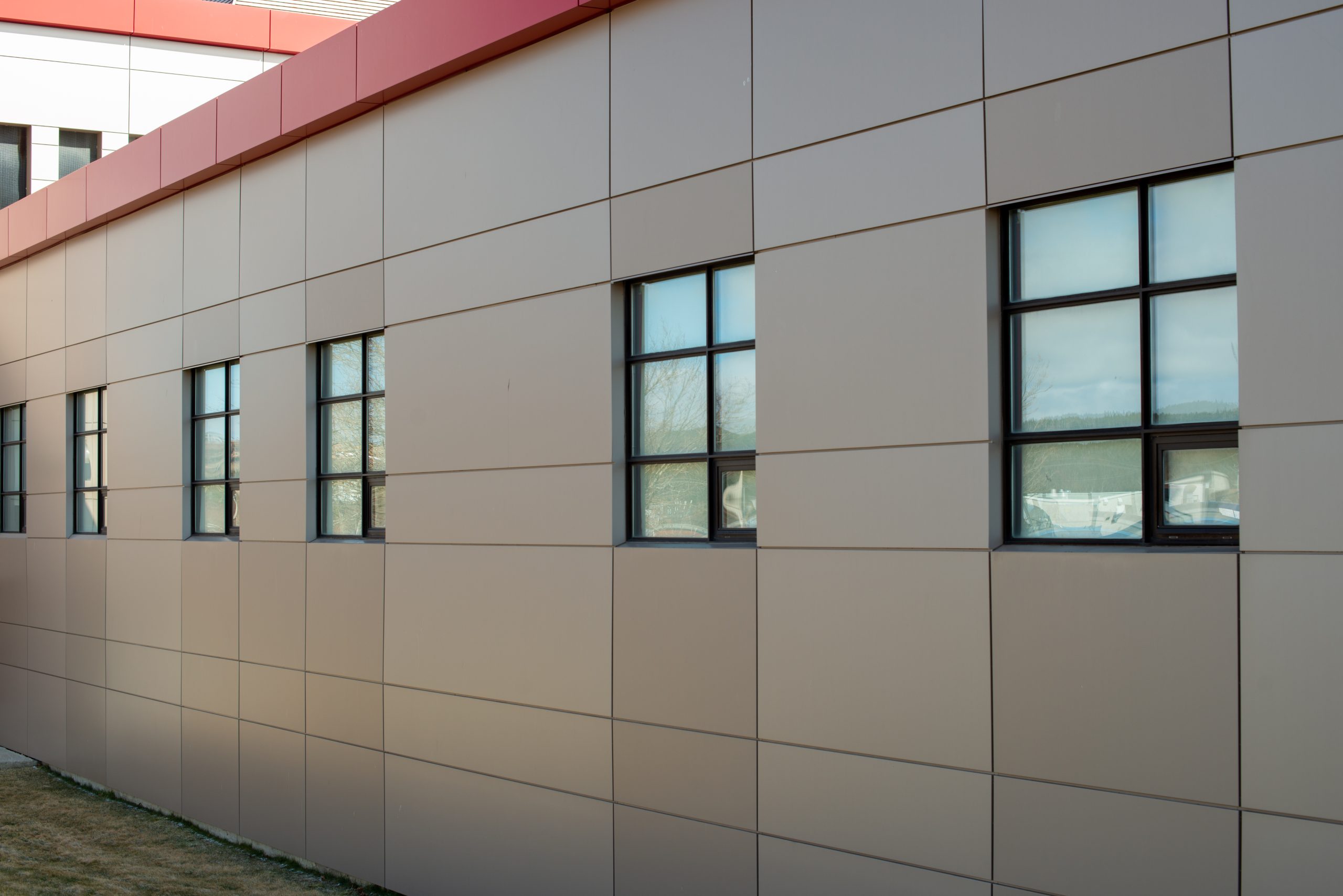
In modern construction, alu panels are widely applied due to the combination of aesthetics and technical efficiency. One of the most prominent applications is building façade cladding, especially for office buildings, shopping centers, showrooms, and high-end hotels and restaurants. With corrosion resistance, UV resistance, and good color retention, alu delivers a modern, refined, and durable appearance to buildings. In addition, alu is used for cladding round and square columns, decorative ceilings, interior partitions, and elevator panels, helping create unified and luxurious spaces. Its excellent bending and cutting capabilities allow alu to adapt to complex designs, curved surfaces, and geometric structures.
For indoor projects, PE-coated interior alu panels can replace many traditional materials such as wood, gypsum board, and stone cladding thanks to their light weight, moisture resistance, and ease of installation. Depending on technical requirements, fire-retardant alu panels can be selected to enhance safety for areas such as corridors, lobbies, and public ceilings.
In addition to advertising and construction, alu panels are also used in industrial applications due to their good mechanical strength, corrosion resistance, and lightweight thermal insulation properties. In industrial zones and manufacturing plants, alu panels are commonly used for partitions, factory ceilings, dust-resistant and moisture-resistant wall cladding, or decorative surfaces for office areas within factories. Furthermore, some companies use alu for fabricating machine enclosures, electrical cabinets, and control panels thanks to its light weight, ease of machining, and resistance to oxidation in mildly chemical or humid environments.
In industrial furniture manufacturing, alu is often combined with steel frames, aluminum profiles, or engineered wood to form modular components that allow quick assembly, saving installation time and costs. For factories near coastal areas or regions with high humidity, the use of corrosion-resistant alu helps extend the service life of buildings and reduce periodic maintenance costs. As a result, alu is increasingly regarded as a durable material solution for modern industry.

Not limited to construction or advertising, alu panels are also used in transportation, product design, and furniture manufacturing due to their light weight, rigidity, and ease of processing. In the transportation sector, alu is used for vehicle partitions, bus and truck interior cladding, container panels, rail car bodies, or mobile control cabins, helping reduce overall weight, improve fuel efficiency, and enhance aesthetics.
In modern interior design, alu is applied in the production of kitchen cabinets, tables and chairs, decorative partitions, display shelving frames, or as a base material combined with glass, stainless steel, acrylic, and other materials to create unique multi-material products. Especially in exhibitions and events, alu is the preferred choice for booths, exhibition stands, and stage backdrops due to its high reusability and ease of assembly. With flexible installation, diverse colors, smooth glossy surfaces, and good weather resistance, alu panels are continuously expanding their applications in daily life and manufacturing industries.
Color diversity is one of the greatest advantages of alu panels. Manufacturers classify colors into main groups to help customers choose more easily:
Standard colors: Solid colors such as white, black, blue, red, yellow, gray, etc.
Glossy colors: Solid colors with glossy surfaces, creating a modern effect.
Wood grain colors: Imitating natural wood grains such as oak, walnut, and teak.
Stone imitation colors: Replicating surfaces of granite and marble.
Brushed colors: Creating a refined brushed metal effect, commonly brushed silver and brushed gold.
Mirror colors: Reflective surfaces like real mirrors, including silver mirror and gold mirror finishes.
Below are five important points to consider when installing and using alu panels:
Do not install or store alu panels in environments with temperatures above 70°C. Panels should be stored in dry and well-ventilated areas.
Maintain an aluminum skin thickness of 0.2–0.3 mm when grooving to enhance strength and flexibility; use V-shaped saw blades or milling cutters with an angle ≥90°.
Use specialized equipment and apply force gradually; do not bend repeatedly. The bending radius must be greater than 30 cm.
Use neutral cleaning agents for cleaning. Do not use strong acidic or alkaline cleaners.
Remove the protective film within 45 days after installation to prevent aging and adhesion of the film to the surface.
You now have a comprehensive and clear overview of aluminum composite panels (alu), from structure, classification, dimensions, advantages and disadvantages to practical applications in advertising, construction, and industry. Choosing the right alu panel from the beginning not only ensures high aesthetic value but also optimizes costs and guarantees durability and safety throughout the service life.
If you need more detailed consultation on specific alu panel types, project-based quotations, or material solutions suitable for your project, please contact MRM Steel for prompt and accurate support from our expert team via MRM Steel Hotline: (877) 289 – 6429. MRM Steel is committed to providing high-quality aluminum composite panels with clear origin, fully meeting technical standards for all applications from residential to industrial projects.